Sunday, September 15th | 2024 | Day 18
With no early class or excursion, I indulged myself by sleeping in. While lounging about, I resisted the urge to text my sister Happy Birthday considering it was two in the morning on the east coast. Time really was winding down and the weight of numbered days suddenly hit me. From that point forward, I was on a mission.
I took the tram to Stazione Unità, then realized I had forgotten my Firenze Card! By the time I went back to the apartment and returned, it was almost one.
Santa Maria Novella was a must-see. Fortunately, it was two minutes from the tram stop and not all that busy. During the fifteen minutes or so waiting in line, I noticed a curious feature on the front of the building.
A thin square slab of marble was mounted perpendicular to the facade. Carved into the marble, a quarter circle arced from upper left to lower right, divided into tens, then further subdivided into tenths of degrees. Arabic numbers marked each ten degrees, while Roman numerals were set parallel to lines radiating from the upper right corner. Around the inside of the circle, signs of the zodiac aligned with the radians. Tapered copper spikes of varying sizes that resembled nails hammered through a board protruded at various points. It was obviously an ingenious celestial calendar that I had to assume marks both equinox and solstice throughout the year.
And indeed it was. Installed in 1572 by Ignazio Danti, the astronomer of Grand Duke Cosimo I, this instrument allowed him to precisely calculate the difference between true solar and Julian years. At that time, the calendar was still based on the one derived by none other than Julius Caesar in 46 BCE. Danti was able to accurately determine the date of Easter and brought his celestial observations to Pope Gregory XIII in Rome. Ultimately, this led to the adoption of the Gregorian calendar—the one used throughout the western world to this day.
Santa Maria Novella is an active place of worship, so like other sacred spaces throughout Italy, proper attire and a certain level of decorum is not only respectful, but expected. Voices should be kept almost to a whisper, which is a few decibels lower than what Americans might consider hushed tones. Designed for harmonious acoustics, stone and marble carry sound remarkably well.
Once inside, I moved along the exterior wall to view a series of tombs. Unlike Santa Croce, they weren’t names I recognized. Though to be honored with such a resting place of course meant they had made significant contributions to Florentine life. On some, low and high relief sculpture was flush with the wall, while others carved out niches with their statuary rendered free from the bonds of stone and plaster. One of the common inscriptions here and that I had seen elsewhere, was the Greek letters alpha and omega with the Chi-Rho in between. I am the beginning and the end, and the way to me is through faith in Jesus Christ.
I sat on one of the pews for a few minutes of quiet contemplation and to absorb the surrounding splendor. At the center of the nave, an early medieval work by Giotto was suspended from the ceiling. Wood panels painted in tempera, with golden backgrounds and gilded edging, clearly depicted Jesus as a man. The immense and very human suffering endured during crucifixion was rendered with striking realism. Blood was shown gushing from the wound inflicted by the Spear of Longinus. His skin had a sickly, greenish-grey cast signifying the very last moments of his existence in this mortal realm. Dated to the end of the eleventh century, records place the cross at the basilica in 1312. Over seven hundred years later, this historically significant piece continues to inspire.
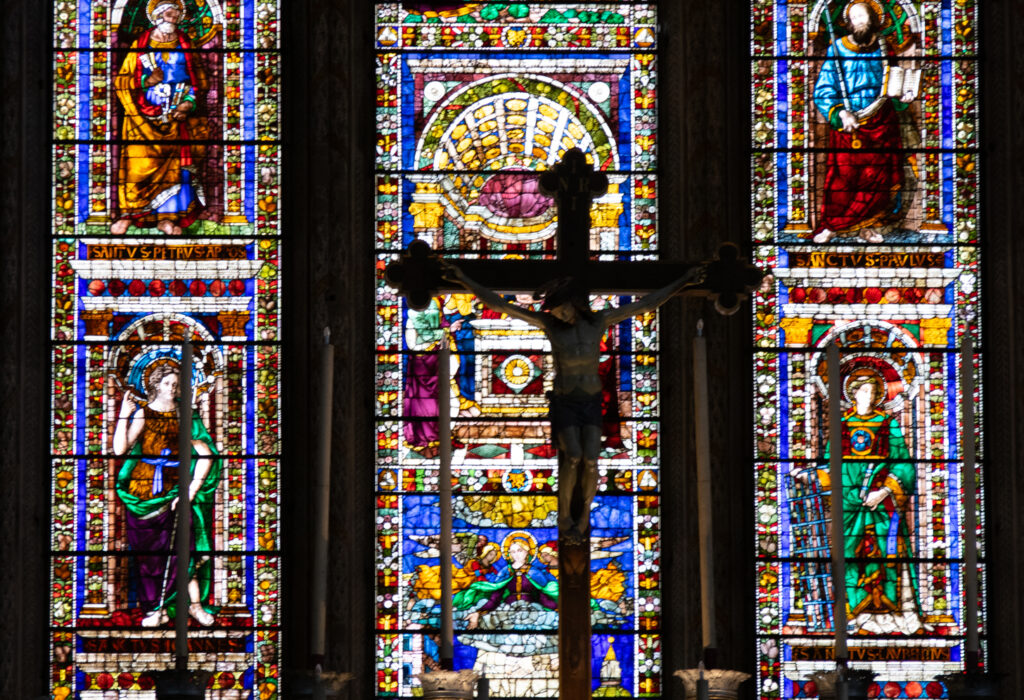
A triptych of finely detailed stained glass windows drew my attention. The altar silhouetted against this ornate backdrop provided a picture-perfect moment. Chapels that bore the names of prominent Florentine families—Strozzi, Gondi, Tornabuoni—lined the apse. As the sun streamed through upper windows certain objects were illuminated brightly, which gave spectacular chiaroscuro contrast to these sacred spaces.
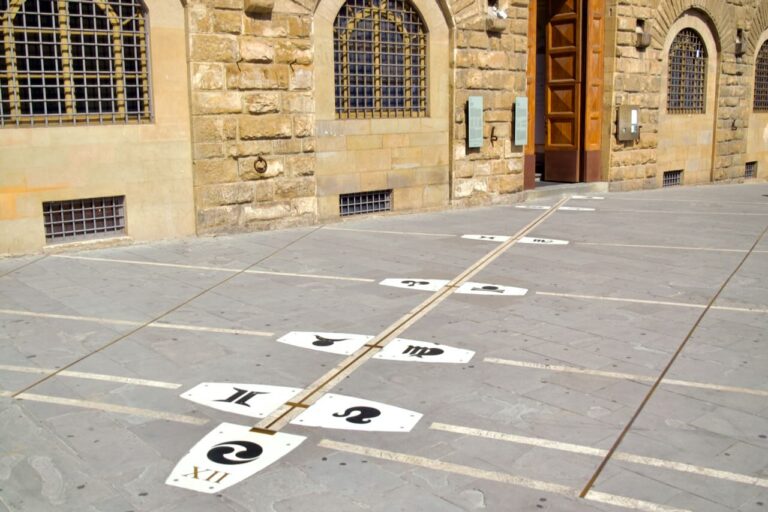
As I went towards the aisle on the opposite side, I noticed a long brass bar with signs of the zodiac inlaid into the marble floor. It began near the entrance and ran at a slight angle to where I had been sitting under Giotto’s cross. Both ends were marked by cherubim-faced medallions of the sun.
This interior line was also installed by the brilliant Ignazio Danti, and was a continuation of the astronomical instruments I had seen on the facade. Pinholes in the rose window and marble exterior act as a solar timekeeping device. Each day, light from the rose window shines directly onto the brass bar at noon. As the angle of the sun changes throughout the year and the midday beam travels the length of the bar, it shines directly onto the medallions to mark the summer and winter solstice. It was pretty amazing and would be well worth timing a future visit to coincide with one of these astronomical events.
After a quick detour to the gift shop for a few small items, I exited into the green cloister to see the Cappellone degli Spagnoli. Originally designed and built as the chapter house of the convent, it was lavishly frescoed with vivid scenes from both Old and New Testaments. It became known as the Spanish Chapel after being designated by Cosimo I de’ Medici to his wife, Eleonora of Toledo and her entourage, for private worship.
I could have spent a lot more time exploring every detail of this marvelous basilica, but after noticing the time, made a hasty retreat for the exit. It was almost time to pick up my hat!
Striding towards Ponte Vecchio, it became apparent why Florence is deemed one of the most walkable cities in the world, and I arrived at Atelier Gatto in true Italian style—only ten minutes late.
Our previous meeting several days prior was brief but as I opened the door, Antonio was expecting me. He stopped what he was doing and greeted me with the same warmth and enthusiasm as before. Per my request, he had widened the brim and resized it to fit—perfectly. I hadn’t asked about price so 300€ came as a bit of a shock. Even so, I was elated to receive this beautiful, one of a kind, tailor made fedora crafted with love by a local artisan.
Several attempts to pay without a great wi-fi connection failed, so Antonio asked if I could go to an ATM. There was one around the corner and on the way out, he insisted I take the hat. The concept of leaving a store with unpaid goods was unfamiliar, but he assured me not to worry.
Inconceivably, the cash machine around the corner was out of cash. The next closest was across Ponte Vecchio near the shop where I had picked up shoes. With that transaction successful, I hurried back and explained why it had taken so long. It was no big deal and as we chatted, Antonio told me he had been pursuing this passion for twenty-five years. It not only meant he was un maestro, but that we were also around the same age. The twinkle in his eyes conveyed genuine joy in following his heart and the satisfaction of a life well-lived.
It is hard to describe how meaningful all of this was. Making a handshake deal, then returning at an agreed upon time, to receive a bespoke item that commemorated my time in Florence made my new fedora much more than a souvenir. It was an unforgettable experience I will always treasure. Beyond that, Signore Gatto was so friendly and trusted I would return to pay. In those twenty-five years, his mastery clearly extended beyond assessing the right fit to correctly sizing character.
Atop Palazzo Vecchio on my second visit, the lovely Eleanora had given me a brochure with two out of the five stickers needed to go on a special tour at no charge. Not wanting to squander her kind gesture, it was now time to complete this mission.
Two sites were within a ten to fifteen minute walk, while the third was on the far end of the Oltrarno. Getting to all three before meeting up with the group for dinner, clear across the city near San Lorenzo would take nothing short of a miracle. Challenge accepted!
I crossed Ponte alle Grazie and walked along the Arno past the massive Biblioteca Nazionale Centrale di Firenze. It was hot so I jagged down a quiet side street to continue in the shade. There were several large abandoned buildings along the way that looked like an old school or barracks. Much of the second story was missing the exterior walls which left individual rooms open to the elements.
At the end of the long block, I crossed the street to Torre della Zecca. It was fortunate to be the only visitor for that time slot and I greatly enjoyed chatting with the docent as we climbed through the tower’s three levels.
As the name suggests, this was where gold florins were minted with machines powered by the adjacent river. She explained it was once part of the eastern gate to the city and turned my attention to the street on the north side of the parapet. In 1865, demolition of the medieval walls began as part of an urbanization plan led by Giuseppe Poggi. The outline of where they once stood is effectively traced by the wide avenues that today encircle the section of the city that lies north of the Arno.
We moved to the south side and she pointed out the concrete structure spanning the river, built to prevent ships of would-be invaders from reaching the city center. The weir also contained a secret tunnel used to transport coins from the mint to Palazzo Pitti. It had long been flooded but a restoration project was underway, and once completed, would be opened to the public. How about that for a cool secret tour during the next visit!
We lingered for a few minutes to take in the view, so I asked about the abandoned buildings passed on the way there. Along Via dei Malcontenti, this was where prisoners were held before being taken to gallows in the Prato della Giustizia—or fields of justice—a short distance outside the old gate.
Though it ended on a somewhat somber note, it was an interesting history lesson with a fantastic view. I thanked my guide and crossed back over to the Oltrarno, arriving at Porta San Nicolò about ten minutes later.
When I first got there, it looked as though the site might be closed for the day. Once a few more people started congregating, I decided to stick around. The docent emerged from a door in the tower and led our small band down to the gate. Telling us a bit about what life was like for ordinary people at the time, he asked us to imagine the gates opening each morning to allow the line of merchants and vendors waiting to enter in order to conduct the business of selling their wares. Danger and filth aside, it was intriguing to think about the sights, sounds, and smells of what that vibrant scene might have been like.
Porta San Nicolò was one of the towers spared the loss of its top floor as most were shortened to allow cannon fire from any potential siege to pass overhead rather than rain rubble onto the homes and shops around them. Once at the top, it was close to sunset and seeing Florence bathed in golden light from this vantage point was spectacular. I could have spent another hour soaking in that glorious view, but had to get going to meet up with the tour group in thirty minutes.
It would have been completely fair for the docent to have asked me to wait, but he kindly escorted me back to where we started. By this point, there was no way I was going to make it all the way to the west gate before dinner. Even if I had tried, there wouldn’t have been another tower tour later that evening. When I asked about the stickers and explained my predicament, it was so nice of him to give me two. Mission accomplished!
According to the maps app, it would be a forty minute walk to the restaurant. Before setting out, I sent a message to Nadia letting her know I was on my way but would be a few minutes late. As gracious and accommodating as always, she said that would be fine and to text when I got there.
The app had not factored in the speed of a hungry guy with an east coast strut and I arrived at Trattoria Zà Zà in under thirty minutes. It was super popular and I felt like a total rockstar when after talking with the hostess, I was led directly to the table. The restaurant was a veritable labyrinth and as we wound our way through room after room, I told her how impressed I was that she knew where to go—even after a slightly wrong turn and backtracking through what seemed like an entirely different wing.
I sat down with just enough time to make quick selections from the menu and took a deep breath. Everyone wanted to know what I had been up to and were excited to share their stories as well. It really was such a wonderful group of people to have shared this experience with.
Back at the apartment, I wished my sister Happy Birthday, then reflected and journaled about what had been one of the most eventful, unforgettable days of the trip.