Saturday, September 14th | 2024 | Day 17
I woke up somewhat early and started the day with a cappuccino at Il Ghiottone. Around the corner from PopArtment, which we called home for the duration of the trip, it became my go-to. I’ve mentioned the caffè previously and the reason for bringing attention to it here is that over the course of those three weeks, it became familiar, as well as a place I became familiar in. It doesn’t take long for that to happen, no matter where you go.
Sitting outside in the fresh morning air, I fully enjoyed the buzz of a busy Saturday. The streets radiating from Piazza San Jacopino seemed to draw the neighborhood into its center. Some came for a coffee, others to see what fresh produce the corner grocer had in. Two guys sat on stone blocks separating the sidewalk from the street while talking over a smoke. A woman in a lovely blue summer dress passed by with her dog as both received friendly greetings from people in and around the caffè.
After her hair appointment across the square, Deb joined me. I had already finished my breakfast and she told me not to wait on her, perhaps concerned that she was holding me up from something more pressing. At that moment, I was exactly where I wanted to be. Immersed at the center of an active Italian community. Sipping my second cappuccino, I was still in awe at being here.
As they were the hub of the neighborhood, Il Ghiottone and San Jacopino were at the very heart of my time spent in Italy.
Once back home and with so much to see, I debated on trying to fit in a stop before the group excursion that afternoon. In the end, I decided to conserve my energy. Though three weeks is a rather long time to visit any place, as an introvert I did have to be mindful to not overextend myself—in stark contrast to the level of excitement I felt.
After a quiet morning, it was time to rejoin the group. Everyone gathered in the lobby at two and loaded up for our last excursion to Lucca, about an hour from Florence.
On every road trip, one of the highlights was Autogrill. If you have traveled across the US by car or bus, you have probably seen some pretty gnarly roadside gas stations. God forbid you should have to use the restroom. In Italy, making a pit stop was always delightful. Like any convenience store, it offered the opportunity for fuel tanks to quench their thirst as well as a wide array of beverages and snacks to refuel those at the wheel. On top of that, there was a deli with fresh sandwiches toasted upon request, cases of pastries, cannoli, and other desserts, plus a full service coffee bar.
I hadn’t had lunch yet so picked up a panino al tricolore with tomato, mozzarella, and basil to eat en route. Three colors representing the virtues of Hope, Faith, and Charity that are imbued in the Italian flag.
We filed out of the van to meet our local guide just outside Porta San Pietro. While the region had been settled by the Etruscans, it wasn’t until becoming a Roman colony in 180 BCE that Lucca began to resemble a town. Walls protecting the new establishment were built around the same time.
In the medieval period the perimeter was expanded, with towers and gates added to repel assault by an army so equipped for the time. With the advent of gunpowder and cannon, fortifications were again expanded and modernized during the age of Renaissance—the walls we see today. That modernization began in 1491, and the mighty walls of Constantinople falling to Mehmed II thirty-eight years prior would have been within firsthand memory of a single generation.
Climbing the steps of Porta San Pietro onto ramparts that once served as a means of defense, we found a place to unwind. The broad, tree-lined path offered welcome shade from the afternoon sun as couples held hands while leisurely strolling in romantic bliss. Bicycles announced passage with the bright ding of a handlebar bell. A joyful reacquaintance after some time away and promises to see each other soon. Two friends sat on a sundrenched bench deep in conversation, as another pair powered by while walking their dogs. It seemed as though everyone was out in this place to be and be seen.
From this one-of-a-kind playground, we descended to a small park and the Cappella Musicale Santa Cecilia. Built in 1930 and dedicated to the patron saint of sacred music, singers, and musicians, it is still an active church and venue for concerts and devotional music. Though relatively new, it has been instrumental in bringing the traditions of liturgical music that reach back to the sixth century, forward for contemporary generations.
The massive Palazzo Ducale long served as the administrative seat of the Lucchese government. After his conquest in 1805, Napoleon ended the long standing Republic, imposed a monarchy, and appointed his sister Elisa as “Princess of Lucca.” Elisa made extensive renovations and redecorated the palace which became her residence. She also had existing buildings cleared and trees planted to create the French-style and aptly named Piazza Napoleone, in which we were now standing.
A statue of Marie Louise, the Duchess of Parma and second wife of Napoleon, stood at the center. Married in 1810, she became the Queen of Italy, and five years later, replaced Elisa as sovereign. Her predecessor had a reputation for lavish court lifestyle and was known for being arrogant and sharp-tongued.
By contrast, Marie earned the admiration of her subjects for being reserved, pious, and dedicated to family, as well as a cheerful, generous, and kindhearted nature. Beloved by most and seen as a benevolent ruler, she restored a more traditional government after a decade of Napoleonic rule. She was also well admired for initiating a series of public works projects—including the shady promenade atop the walls. It comes as no surprise that her vibrant spirit and contributions to the people of Lucca continue to be celebrated.
Making our way through the adjacent plaza, an antiques market offered a lively scene as locals and visitors scanned tables crowded with items in search of hidden treasures. Several from the group stopped to peruse for a few minutes. A trinket caught Deb’s eye and when she asked how much, the gentleman replied “un regalo, per Lei”. She was pleasantly surprised by the gift and thanked him before moving on, grinning ear to ear.
Those that had lingered in the market caught up at the Duomo di San Martino. Built in the eleventh century, the facade was exquisitely decorated.
Between two of the portico arches, a marble statue of Saint Martin mounted on horseback depicted the scene of compassion in which he saw a beggar shivering by the roadside, cut his cloak, and gave it to the poor man to ease his suffering.
The three colonnaded tiers that rose above the portico were inlaid with intricate vegetal designs, symbols, and depictions of animals and people. Most striking was that almost all of the columns were unique—from unadorned colored stone, to geometric patterns, to ornate relief.
Over eight feet tall, a wooden statue of Jesus on the cross was the most precious relic at San Martino—the Holy Face of Lucca. According to legend, it was carved by Nicodemus, one of the men that helped Joseph of Arimathea entomb the body of Christ. At the time of our visit it was undergoing restoration, so I wasn’t able to see it in situ. However, the workspace was visible behind glass and it was just as fascinating to see where this painstaking effort was underway.
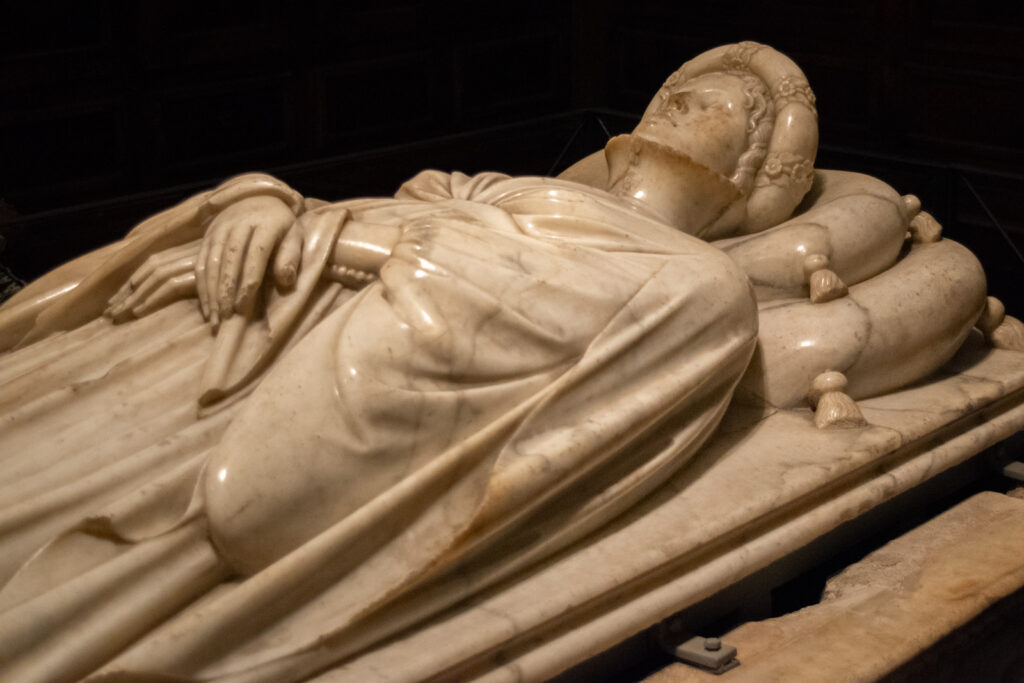
My favorite work at San Martino was the sarcophagus of Ilaria del Carretto. She was a noblewoman married to the Lord of Lucca, Paolo Guinigi. It is well known that for marriage at the time, and especially those among aristocratic families, love was not a requirement. The match between Paolo and Ilaria seemed to be one of the exceptions, as the couple were genuinely enamored with and dedicated to each other. When she died at the age of twenty-six after giving birth to their daughter, her husband was truly bereft, and in his grief, commissioned this beautiful monument to commemorate their love and devotion.
From San Martino, the tour continued down quiet back streets, passing by the conservatory where Puccini trained and Torre Guinigi, attached to the palazzo where Paolo and Ilaria once lived.
We emerged from a thick stone tunnel into an ovoid expanse unlike the rectilinear squares I had seen elsewhere. Our guide explained that we were standing at the center of a Roman amphitheater! The restaurants and apartments around Piazza dell’Anfiteatro had been incorporated into and built on top of the ancient structure. It was so cool to imagine living in a space where the trend of exposed brick would reveal those dating back almost two thousand years. On the other hand, trying to hang a big screen without serious objection from the department of antiquities must be a pain.
The group exited the opposite side of the amphitheater onto Via Fillungo, which was the Cardo Maximus, or primary north south axis of the Roman grid. Today, it is the main shopping district and was packed with residents and tourists browsing numerous high end brands interspersed among a variety of souvenir shops, local caffès, gelaterias, and restaurants. Though filled with people, it was not crowded to the same extent as Siena or Florence.
As we wove our way through narrow streets, the tour came to a close at Chiesa di San Michele in Foro. Also constructed in the eleventh century, over the Roman forum, the facade was quite similar to San Martino in several ways. It was composed of colonnaded tiers with mostly distinct columns. The lintels of green and white marble were inlaid with sacred symbols and also depicted people, animals, and mythological creatures. Vegetal designs graced the moldings that lined the top edge of each tier.
One feature of San Michele that set it apart was the twelve-foot statue of Archangel Michael standing at the crowning peak. Revered across Abrahamic faiths as the commander of God’s heavenly army, he also serves as protector of His people, and champion of the struggle against evil. With this figure towering over the square, holding the Globus Cruciger, I took pause. I didn’t come to Italy to become Catholic. Nor had I come to “find Jesus.” Though perhaps, a significant aspect of this journey was about finding faith—in beauty, in history, and in the whole of humanity.
With some free time before dinner, Chris, Maxine, and I stopped at one of the bars adjacent to the chiesa for a couple of drinks. Everyone remarked about how incredible the trip had been and that it would be ending far too soon. Nadia and Deb joined us and shared in our commiseration. Having directed many tours, Nadia again expressed how wonderful a time she had with us.
I felt so grateful. Not only for the opportunity to be there in the first place, but for everyone I had the pleasure of being with.