Thursday, September 5th | 2024 | Day 8
Up early for class at 9, our first lesson was on an unfolding scandal involving the Minister of Culture who appointed his former mistress as a consultant on his staff. While ideas around extra marital affairs are somewhat more lax in many European countries compared to the US, access to potentially sensitive documents is not.
For the second lesson, our insegnante Giusy, took the crew to Mercato di Sant’ Ambrogio—the real market where Florentines shop. The forecast didn’t disappoint and we walked quite a ways down Via degli Alfani in drizzling rain. Vendors with a wide array of produce were outside under blue tarps, though Giusy seemed a little disappointed, saying there was less of a turnout than usual. Moving into brick and mortar, the sights, sounds and smells were divine. Mini shops arranged along four aisles offered pizza, panini, fresh meats, cheese, olives, wine, and pasta with proprietors eager to offer samples. They didn’t have to twist my arm nor was much imagination required to see myself here a couple times a week once I move to Italy.
After gathering around a high-top table in the center of the market to complete a worksheet, Deb and I headed back towards the school. By the time we had reached the intersection where we parted ways with the rain varying from drizzle to steady sprinkle, we were both pretty soaked. My backpack was in the classroom, so I stopped to get it before moving on to San Marco.
Upon entering the Basilica di San Marco I immediately felt a sense of tranquility. Not only because it wasn’t flooded with tourists, nor was it due solely to grey skies offering a welcome reprieve from the heat of days prior. It was the elegant beauty of simplicity that came over me while I sat in the cloister soaking in silence and rain. I can see why Cosimo di Giovanni de’ Medici came to his private chapel here to “retreat from the world.”
Inside, tempera painted wood panels by the somewhat overlooked early Renaissance master Beato “Fra” Angelico hung on the gallery walls. In his time, being a Dominican friar was at odds with being a painter. Deemed an indulgence and distraction from prayer, these objections were overcome by sheer talent which, in his own defense, contributed to the glory of God. For Fra Angelico, painting was a form of penitence and meditation. Now separated from their original contexts as altar pieces, it is understandable that the significance and meaning of these devotional works might be lost.
Going upstairs, the entire second floor consisted of tiny rooms where the friars slept and prayed. With barely enough space for a bed and small nightstand, their dedication to living simply, in service to God was evident. Most of the cells had a single painting or fresco, which were assumedly meant to guide the occupant in prayer on a particular theme—Jesus crucified, the Resurrection, Mary as the mother of Christ, and her assumption into heaven.
Of course I was taking a lot of pictures and in trying to get a better shot, nudged a door to one of the cells ever so slightly. An alarm immediately sounded. Oh Lord, I’ve done it now. The scene I envisioned of armed guards charging up the stairs to levy a hefty fine or arrest me thankfully didn’t unfold. Do-de-doo, nothing to see here!
Another well known Dominican to call San Marco home was Girolamo Savonarola. Though certainly not the only person to take notice of Medici power and control over Florence, he was perhaps one of the most outspoken and influential in turning public opinion. Advocating for the return to a simpler, and from his point of view, less corrupt time, both elites and ordinary citizens were encouraged to relinquish earthly possessions. In bonfires of the vanities, an unknown number of books, paintings, music, sculpture and other finery deemed sinful were destroyed. Savonarola had been invited to preach in Florence by Lorenzo the Magnificent, but within a few years, religious fervor against social and artistic excesses led to the expulsion of the Medicis.
With Savonarola’s grip tightening around the spheres of both religion and politics, the Republic seemed to be teetering precariously, leaning towards a backslide into Middle Age tyranny. Ironically, the same accusation had been levied against the Medici by both noble rivals and the preacher.
For however much the citizenry mistrusted or disliked the Medici, strict doctrine removed many freedoms that in part, gave Florence its identity as the center of scientific and humanistic thought. Perhaps the devil they knew was better than the one they didn’t. Eventually the pendulum of public opinion, as well as that of the Pope, swung against Savonarola and he was hanged, then burned in Piazza della Signoria—the same location where his bonfires had blazed a short time before.
In the back corner of San Marco, Savonarola is remembered. One glass case held his frock, another his rosary. A marble slab with a relief and inscription paid homage to him as an orator, thinker, and citizen. At the top, a bronze bust revealed his likeness. Whether or not one agrees with Savonarola on theology, you have to admire a man rooted in the courage of his own conviction. Someone who had a sense of purpose, and lived and died according to what he believed to be God’s will.
On my way back down to the ground floor, the same alarm sounded again. Wasn’t me this time, and I smiled at the quick realization that correlation doesn’t mean causation.
Entry to the Accademia was about an hour away so it was time for lunch. One cannot see great works of art on an empty stomach! In the spirit of what I was about to see, I stopped at Caffetteria il David. It is on the same block as Gran Caffè San Marco and All’ Antico at the south end of Piazza San Marco. The only seating was a narrow bar but it wasn’t busy and the Margherita panini was delicious.
Standing in line, the rain maintained a steady drizzle. My jacket did well enough against the weather, but offered no protection from the pointed ends on the mass of umbrellas that surrounded me. Luckily I didn’t lose an eye before having a chance to see Michelangelo’s masterpiece. The queue was rather full but moved efficiently once it was time to go in.
While many went straight ahead, the first gallery to the right caught my attention. Spiraling upward, the plaster model of what is considered Giambologna‘s masterpiece depicts the Rape of the Sabine Women. A narrative as central to the early history of Rome as the legend of Romulus and Remus, yet much more likely to have been a reality. While the subject is horrific, the work was exquisitely striking. Writhing, twisting in anguish and lust, each figure is composed so dynamically that the scene practically came to life. The finished sculpture can be found in the loggia outside Palazzo Vecchio.
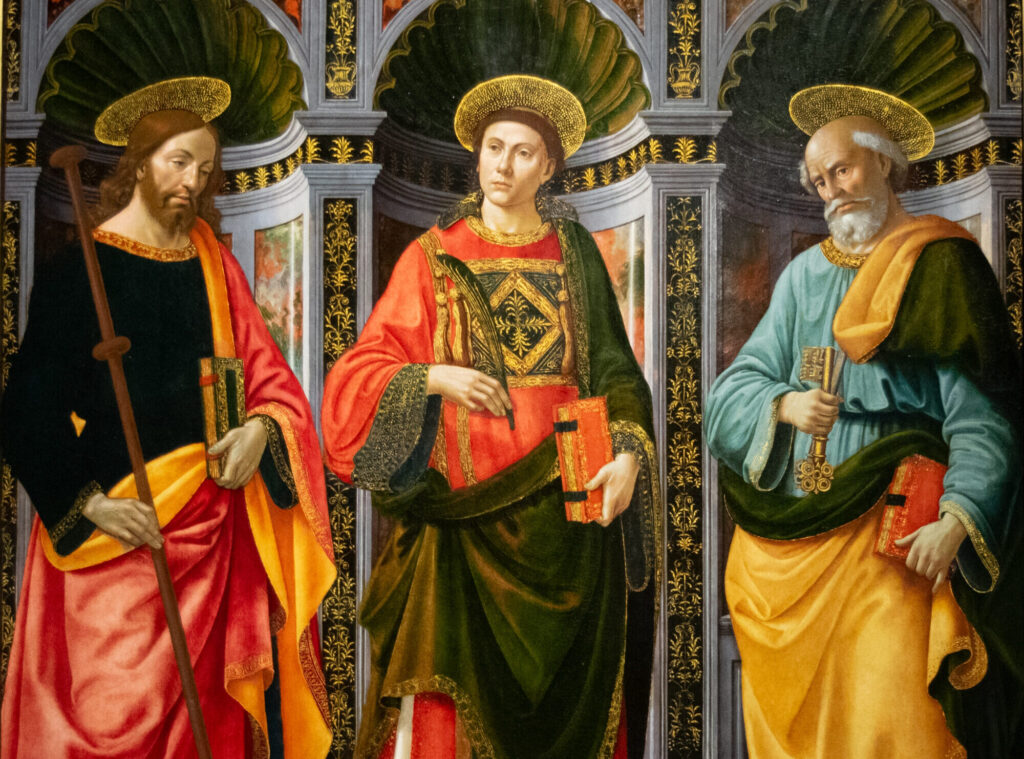
Much of the wall space was filled with paintings and altar pieces. Slightly cramped, there wasn’t enough room to capture decent photos. As luck would have it, a tempera on wood of Saint James the Great, Saint Stephen, and Saint Peter was in a good spot. Lucky because Santo Stefano is one of my favorites.
Mentioned in the book of Acts, he was put on trial for blasphemy. Speaking eloquently, he took exception to the hypocrisy of those who had condemned Christ to the cross, persecuted his followers, and now sat in judgement of him. Taken outside the walls of Jerusalem to be stoned, Stephen became the first martyr of Christianity. Ironically, Saint Paul who stood beside him in the painting holding the keys to heaven, was one of the Pharisees and actively participated in the execution. Steadfast in faith as death was imminent, Stephen prayed for Jesus to take his soul, and to forgive his persecutors for their sins.
At the center of the Accademia and the heart of Florence itself—the David. Carved from a single block of Carrara marble by Michelangelo, who was twenty-six when he accepted the commission, is an absolute marvel. Unlike contemporary works that portrayed victory, Michelangelo chose to capture the moment just before the biblical battle with the Philistine giant, Goliath. From the side, his gaze is fraught with the weight of not only the challenge directly in front of him, but also that of leadership and becoming a king. David was, after all, a simple shepherd, and victory against such a formidable foe was sure to elevate him to heroic, god-like status. Looking at the colossal figure straight on, he stares openly and optimistically into the future.
Much like David facing Goliath, the statue perfectly represents a moment in time. Beset on all sides by rival city-states more powerful than she, Florence stood strong in the face of what appeared to be insurmountable obstacles, while also gazing towards the future. The city charted its own course—one the rest of humanity would eventually follow in the wake of.
Off to the left, the Gipsoteca Bartolini was originally created in 1784 by Grand Duke Peter Leopold. The hall of models was intended for students of the Accademia delle Belle Arti next door as reference when creating marble sculptures. I spent quite a bit of time here, much of it waiting for clean shots as others passed by. Though these plaster models, less detailed than their counterparts in stone would have been, the themes and expressions were just as captivating.
The next gallery featured works by Giotto, another one of my favorites. When I took Art History classes in college, he was pointed out as the first known artist that clearly broke from Gothic and Byzantine tradition to herald a transition into the early Renaissance. Though vanishing point perspective came later, Giotto did use geometric principles that made buildings and interior spaces appear much more realistic. The most dramatic shift was in the way he represented people. They had volume, took up space, and were properly proportioned. While on this trip I had hoped to make it to the Scrovegni Chapel in Padua which is considered his masterwork. Yet another site for the next adventure in Italy!
As I stepped out from the Accademia, the rain was tapering off and it was time to decide where to go next. Museo di Medici was only a few blocks away and, as they say, perché no? As I approached the museum, the first floor of a building around the corner covered in street art caught my eye.
Graffiti is an Italian word meaning “scratched” that stems from the Greek verb “to write.” Vows of devotion and discontent once carved into ancient stone are today conveyed in spraypaint. Regardless of sentiment, the long standing tradition of making one’s view publicly known is nothing new.
I loved the freedom represented on those walls. This was exactly the foundation laid in Florence, that built towards the Magna Carta, that built towards the Enlightenment and values we should all be fighting for. While the revolutionary, wanting to change the world side of youth was pumping my fist and marching beside them, the more temperate and perhaps wiser side suggested that cooler heads prevail. “Odia gli USA, odia Israele; ama il prossimo.” Hate these people, but love thy neighbor seemed rather contradictory. Florence is hardly the only city in Europe faced with over tourism, but I agreed with this sentiment cento per cento: “Basta svendere Firenze. +Studentati -Privati.”
The Museo de’ Medici is located in the Rotunda del Brunelleschi, a Renaissance church designed by the same architect who built the famous dome, but left unfinished until the early twentieth century.
Arranged chronologically, galleries packed with artifacts and details ringed the central space, bringing the visitor through the history of this illustrious family. Each room had a QR code to scan with a smartphone to get an audio tour in English, French, or Italian. One of the galleries had a slideshow featuring brief biopics of prominent figures. It also offered a welcome chance to sit and rest for a while.
Panels in the center displayed each period of Medici history, as well as a family tree from Cosimo the Elder to Anna Maria Louisa de’ Medici. It was quite fascinating and really helped when trying to keep all the Cosimos, Giovannis and Lorenzos straight!
You may be able to tell by now, but I’m kind of a fan. One could debate all day long about rivalries, power grabs, usury, and influence (aka bribery) leveraged to determine who the conclave elected Pope. Less debatable is whether the Medici were first or last to do so. While such accusations were certainly levied, and therefore likely carried some grounding in truth, I do believe the broader vision led to greater good than ill. However odious the backroom political chicanery, there is no doubt the Medici embraced ideals of humanistic thought and scientific discovery, gave much to those in need, and conspicuously sponsored some of the greatest artists who defined the Renaissance. The means don’t always justify the ends, but in this case, I’ll take it.
As I headed back to the Duomo, the rain finally let up. I took a few minutes to lean against the iron gate surrounding the Baptistry while I decided what was next. Being amidst the endless, swirling mass of tourists, street vendors, and fashionably dressed Italians was a wonderful feeling. It was way past time for a spritz, so I took a seat at Move On, hoping for some good shots of the facade of the cathedral.
Move On was rather apropos for the current situationship I was in. Someone I cared a great deal for but wasn’t in a place to make anything official. Someone I tried to help—even rescue—because I cared and believed in her. There was also something about her that brought out a deeply rooted aspect of myself that wanted to be in the role of protector and provider. Over the previous two years, the road had already been quite rocky and there were many signs it was time to let go.
Shortly after sitting down, four guys occupied an adjacent table for two. Remembering to be situationally aware, I started to feel somewhat guarded and moved my backpack from across the table to the chair beside me.
Suddenly, the sun broke through the clouds and the facade of the Duomo lit up. Perfetto! This was the moment I had been waiting for. After snapping at least a dozen shots, the server, seeming concerned about the distance I had been from the table, was waiting to ask if I would like another spritz. Certo, per favore!
When I returned to the opposite side of the table I had been sitting at, I unnecessarily explained in Italinglish™ “il sole.. it was in my eyes.” He smiled and as we started talking, told me they were from Israel and had come to Florence to escape the war. At that very moment, two of them were on the phone trying to extend their visas out of concern for what hell might await upon return. They were all young but certainly eligible for military service. He shook my hand and introduced the group—his name was Michael. As they finished their tea and stood to leave, I felt more than a little sheepish for any concern I had a few short moments ago.
In that brief interaction, I was humbled and reminded that while one should be cautious and aware, the entire point of traveling is to connect with the world and more importantly, the people in it. Reminded that we are all travelers in space and time. That perception shapes reality and the power to choose whether our experience is one of love or fear lies within each and every one of us.
As the golden hour glow continued, I couldn’t help but take a few more pictures.
A gorgeous woman sat down next to me at the table where the Israeli gentlemen had been, ordered a spritz, and pulled a few letters out of her purse. She wrote, I snapped pics. Speaking in English to the waiter, I was relieved to stop rehearsing what I might say in Italian, and asked where she was from. Czech Republic—where my family would be spending Christmas.
Our conversation ranged from art, to Prague, to what was next in life. I had the impression Adela and I were both facing formidable forks in the road. Career, relationship, how and where to find our place in the world. It would have been so cool to spend time with someone passionate about art while in Florence. Though I imagined a day together before she left and the possibility of meeting up in Prague over the holidays, I didn’t ask for her number. Perhaps out of not wanting to be too forward. Maybe out of a sense of loyalty to someone I wasn’t in a relationship with, but wanted to be. As I watched her walk away, I couldn’t help but wonder what this chance encounter could have been.