Wednesday, September 11th | 2024 | Day 14
Today, the group was up early for another exciting road trip! After a quick briefing from Nadia on the day ahead, over house coffee at PopArtment, the Eurovan left promptly at eight.
Colle di Val d’Elsa, or “hill in the valley of the Elsa,” was a popular stop on the Via Francigena, a medieval route for pilgrims on their way to Rome from northern Europe. Today, it is central to the production of fine Italian crystal. Our first stop was at Collevilca, one of the plants manufacturing a wide array of objects both practical and decorative. I used the term “plant” rather than “factory” because it was neither mechanized nor automated in the way someone from the US might envision. After being welcomed by our hostesses, it was a special treat to get a tour of the shop floor.
Molten glass heated in furnaces blazing at over a thousand degrees was passed from one station to another before being assembled into the final product. In a matter of minutes, one man rolled out the bowl before passing it off to another. A third brought a glob of heated material on a long rod held above the second man’s head. Using a pair of industrial snips, the viscous goo was attached to the bowl and expertly shaped into the stem and base. Within ten minutes, they had made at least six perfectly uniform wine glasses ready for their first pour of Chianti.
At a separate station, another gooey ball was being shaped with large tweezers. It was hard to tell what was being made as the man gently pulled two delicate strands, then a larger one before carefully turning it over a few times to mold the final form. He proudly stood the iron rod on end and let me take a picture of the snail he created.
It was such an honor to see this group of craftsmen at work. Though the shop certainly had molds, presses, and other devices, these crystalline pieces of art were almost entirely handmade using techniques passed down for generations—skills practiced for years and honed to perfection by each individual artisan. This is one of the aspects of Italy I love the most. Rather than stamping out cheap tchotchkes as quickly and profitably as possible, there is a reverence for tradition. For honoring the time it takes to make something of quality by hand.
Collevilca was the place I decided to pick up souvenirs for my two sons. Though somewhat concerned about these fragile objects surviving the journey back home, I wanted to bring back something other than a Firenze t-shirt which they would quickly outgrow. Something unique and meaningful—a reflection of true Italian spirit.
As we loaded back onto the van and wound our way towards the medieval city, each turn offered a different, more tantalizing view of what was to come. Arriving at the west end of town, we disembarked to continue on foot. Two massive, round towers straddling the Porta Volterrana, stood guard over a short bridge and the earthen depression that had once been a moat.
Set atop a narrow hill, the part of Colle di Val d’Elsa we walked through accommodated a single main road through its center. Below the hilltop fortifications, the town fanned out in several directions, primarily to the south. There was more to see than expected and the many signs advertising “Vendesi” made me wonder if retirement would be manageable in such a small commune. I wasn’t quite ready to put in an offer, though worse fates could befall me.
From Colle, we were off for lunch. Once the van parked, it was a short walk up the hill before passing through a narrow gate that pierced the massive stone wall. Monteriggioni was the smallest town we visited on the tour. While beautifully picturesque, I don’t know if I could live in a village with around fifty permanent residents. I also thought about how dark and quiet it must be at night—a perfect spot for stargazing.
Ristorante Le Torri Monteriggioni was small and family run. I mean to use the word small as a delightful quality, and perhaps intimate is a better descriptor. Having a meal at these kinds of places felt more like being invited to dinner in someone’s home rather than shuttled through a local chain restaurant. Everything was made fresh with quality ingredients and they were proud to share with family, friends, and strangers alike.
Once seated at a large round table on the shaded patio, homemade sourdough and pumpernickel were served along with a fantastic bottle of Bianco di Toscana vinted just outside the walls at Castello di Monteriggioni. A perfectly prepared salmon almondine with green beans was the main course.
Our cameriera was absolutely lovely and looked so similar to Drew Barrymore—who I and everyone else born in the seventies has a crush on—that I wouldn’t have thought twice if she had told me they were related. Once again I found my thoughts leaning towards limerence. Sharing a simple, elegant Tuscan home and la dolce vita with a beautifully kind woman.
Throughout the meal as conversation bounced around, I had to sit back and just take it all in. Here I was on a tiny hill in a tiny Italian hamlet, enjoying the sights, sounds, and tastes of every moment. What made it truly a blessing, was being in the company of such wonderfully interesting and well-traveled companions.
Well sated and after a half hour to stroll around, we loaded back up for the next destination.
Siena has remained largely untouched since the Middle Ages and is today most widely known for its iconic bell tower and the Palio. It was the first center of banking in Tuscany, before being eclipsed by Florence. Siena and Florence were also rivals in pursuit of control over the Chianti region and fought several battles in the thirteenth and fourteenth centuries, including one at Colle di Val d’Elsa.
A local guide met up with the group and while winding our way through narrow streets, he explained some of the history and culture of the Palio. Twice per year, the Piazza del Campo is transformed into a sand track laid for one of the most famous horse races in the world. It is a dangerous, nail-biting, three laps that lasts a mere ninety seconds.
The seventeen contrada, or neighborhoods, in the historic center of Siena are centered around a piazza, a church, and a fountain. Our tour led us through the Snail, Panther, and Eagle wards, each of which were clearly delineated by flags and symbols of their representative mascots ensconced into the masonry. In one of the squares, young men dressed in full Renaissance regalia were practicing tossing flags in the air and to each other. The traditions and accompanying rivalries run centuries deep.
Only ten of the seventeen contrade have a horse in the race. Seven that didn’t participate the year before, with the remaining three drawn by lottery. Once the race has been won, a coveted silk banner, or Drappellone, is carried off by the victors to be displayed in the neighborhood museum which entitles them to buona fortuna and serious bragging rights. From there the age-old cycle starts anew. I can only imagine how such pageantry and the sense of place in time must instill incredible feelings of pride for belonging in one’s community as well as the city at large.
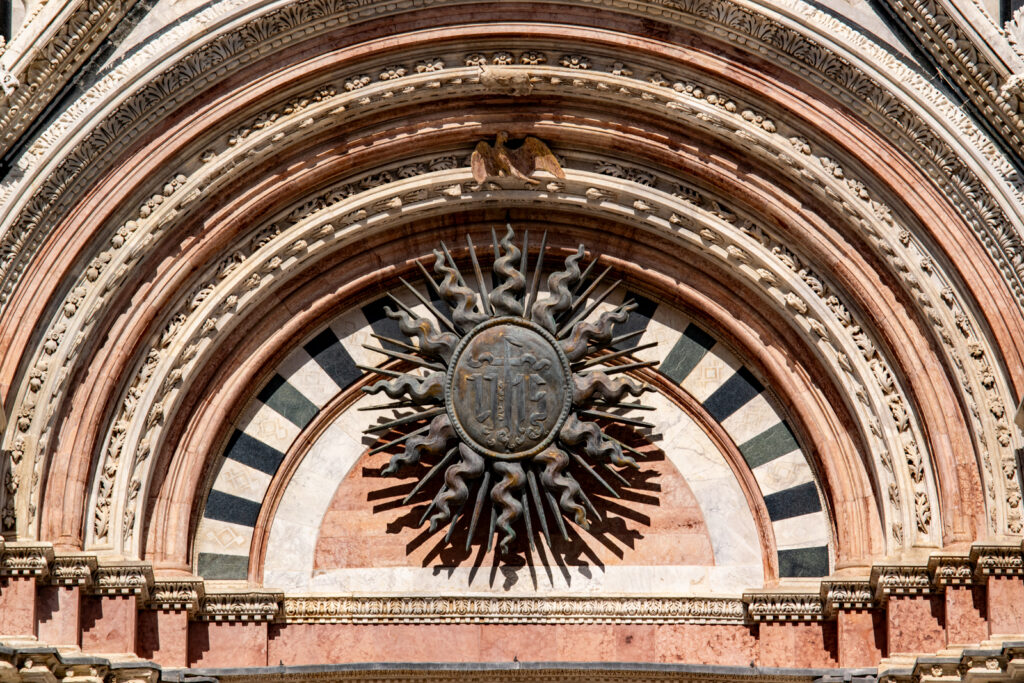
Emerging out of the confined neighborhood streets, the Duomo di Santa Maria Assunta rose skyward in white marbled splendor. Three gables with gold tesserae shimmering brilliantly in the afternoon sun crested the facade. In the central scene, Jesus was seated on a cloud, while Mary kneeled to receive the crown of heaven he was about to place on her head. Angels on either side of their heavenly perch heralded tribute and joy through golden trumpets. It reminded me of Byzantine mosaics, which was fitting given the enduring influence and popularity of that style in the late Gothic period. Though these architectural features were added during the Neo-Gothic movement of the nineteenth century, they felt in perfect harmony with the original structure.
In contrast to the relative flatness of the mosaics, each layer of the facade was ornamented with sculpture. Dozens of gargoyles protruded outward to offer protection from evil spirits. Numerous apostles, prophets, and philosophers stood upon cornices as a reminder of the many sacrifices and contributions made in service of both the rational and spiritual evolution of humankind.
Moving through an open portal, the interior was nothing short of breathtaking. Columns of alternating black and white marble carried the arches and vault soaring to well over a hundred feet. The striped pattern was reminiscent of the Islamic style prevalent in southern Spain after the Moorish invasion of 711, so I wondered if and how that may have been influential here.
Completed in 1268 by Pisano, who is considered the founder of modern sculpture, the pulpit carved out of Carrara marble was enveloped by chiaroscuro reliefs. Themes of Salvation, the Last Judgement, and scenes from the life of Jesus must have been powerful images for the congregation to contemplate while sermons were being delivered.
A bronze statue of John the Baptist by Donatello stood in a chapel dedicated to the saint. The camel hair garment draped over him signified his solitary, ascetic life in the desert. In his left hand, John held a cross-shaped staff symbolic of Jesus’ sacrifice, and a scroll associated with his declaration of Jesus as the lamb of God. These details would have left little room for misinterpretation amongst the largely illiterate population of the time. Most striking was the emotion expressed by San Giovanni, wrought with anguish over the future he had foreseen.
Commissioned by cardinal Francesco Todeschini Piccolomini, the massive altarpiece bearing the name of a prominent Sienese family was originally intended to be his tomb. Also carved from Carrara marble, this final resting place was built by Andrea Bregno until 1485 when declining health forced his exit, leaving the project unfinished. In search of new talent, Piccolomini entrusted the remaining sculptures to a young Michelangelo, who was in high demand after being lauded in Rome for his recently completed Pietà. The burgeoning artist completed four of the statues in the niches of the altarpiece—saints Peter, Paul, Augustine, and Gregory.
Not to be overshadowed by the rich embellishment of its surroundings, the intricate designs of the marble floor were exquisite works of art that stood on their own. Described by Giorgio Vasari as “the most magnificent pavement ever made,” it would be difficult to find a contender anywhere in the world. Framed by ornate floral and vegetal designs just as noteworthy, scenes from the Old Testament covered, not just a certain area, but the entire expanse of this massive church. I didn’t know it at the time, but the floor is only fully revealed for six to ten weeks per year, typically spanning the month of September. It was a matter of chance for me, so if you want to see the Siena Duomo in its full glory, plan your journey accordingly.
It is somewhat difficult to come up with enough superlatives to adequately describe how stunning, and at times overwhelming, it was to be amidst such incredible beauty. At every turn, whether in stone, wood, or pigment, another masterpiece was waiting to be admired. I suppose Europeans are well accustomed to being immersed within the epic past of their own history. I’ve been to a lot of places in the US—DC, New York, San Francisco, Chicago, Boston, Philadelphia—to name a few. Undoubtedly, each of these cities have modern marvels, interesting architecture, and many great historical sites and museums to see. That said, for me, nothing compares to the wonders abroad that span millennia.
In similar fashion to other sites we visited, I could have spent a great deal more time exploring and taking pictures. After a text from Nadia saying the group was ready to move on, and not wanting to hold everyone up, I hustled out of Santa Maria Assunta.
Navigating through streets flush with Italians and tourists alike to keep up with the group, it was a bit like missing the forest for the trees. Our guide expertly wound us up one last incline to the staircase leading to Piazza del Campo. While I wouldn’t necessarily describe the journey through medieval Siena as claustrophobic, this open expanse certainly felt like a breath of fresh air. With many thanks, we bid arrivederci to our guide before a bit of free time.
Maxine, Chris, Susie, and I found a spot at a caffè on the piazza, and chatted over a couple drinks. You would never guess, but it was a round of Aperol spritzes. Once again, I had to sit back and take it all in, while feeling beyond grateful. Scenes I had only been able to view in pictures were right before me. After such a long time dreaming of Italy, this adventure was the best gift I have ever allowed myself to receive.
Siena was absolutely beautiful and I would love to spend more time there, especially to be swept up in the passion and fervor of the Palio. That said, I have to be honest. As everyone walked up the hill at the beginning of the tour, we often rushed to split on either side of the street as cars came through. Sometimes cars were going the wrong way or in areas that were clearly indicated as pedestrian only. Drivers weren’t exactly careless but they didn’t seem patient or overly cautious either. Some of the folks in our group weren’t super agile and I suppose I felt a bit protective. In the end, nobody was run over, but I felt a sense of aggravation from drivers navigating around pedestrians that I didn’t experience elsewhere.
After two incredible days of active sightseeing, it was nice to return home and enjoy quiet time to journal and do laundry. While I stood there ironing, taking far too long on three shirts, I pined for a dry cleaner. Crossing paths a couple times between loads, a Persian woman from Canada and I got to talking about what brought us to Florence. She and her husband had also come after many years of dreaming.
It was one conversation of many that solidified my sense of how uniquely special Florence is. The draw it has across cultures, ethnicities, and backgrounds. Is it the art and philosophy? The monuments and their history? Absolutely.
I would also say it is the spirit at the heart of Humanism itself: the budding notion that each person made in the image of the creator is, by nature, endowed and deserving of certain unalienable rights. The truth of human dignity, regardless of social status or myriad other constructs used as means to foment division. These tenets were foundational to both the Enlightenment and the American Declaration of Independence. People identify with and strive towards these higher ideals because they resonate as universal truths beyond borders, fealty, or polity.